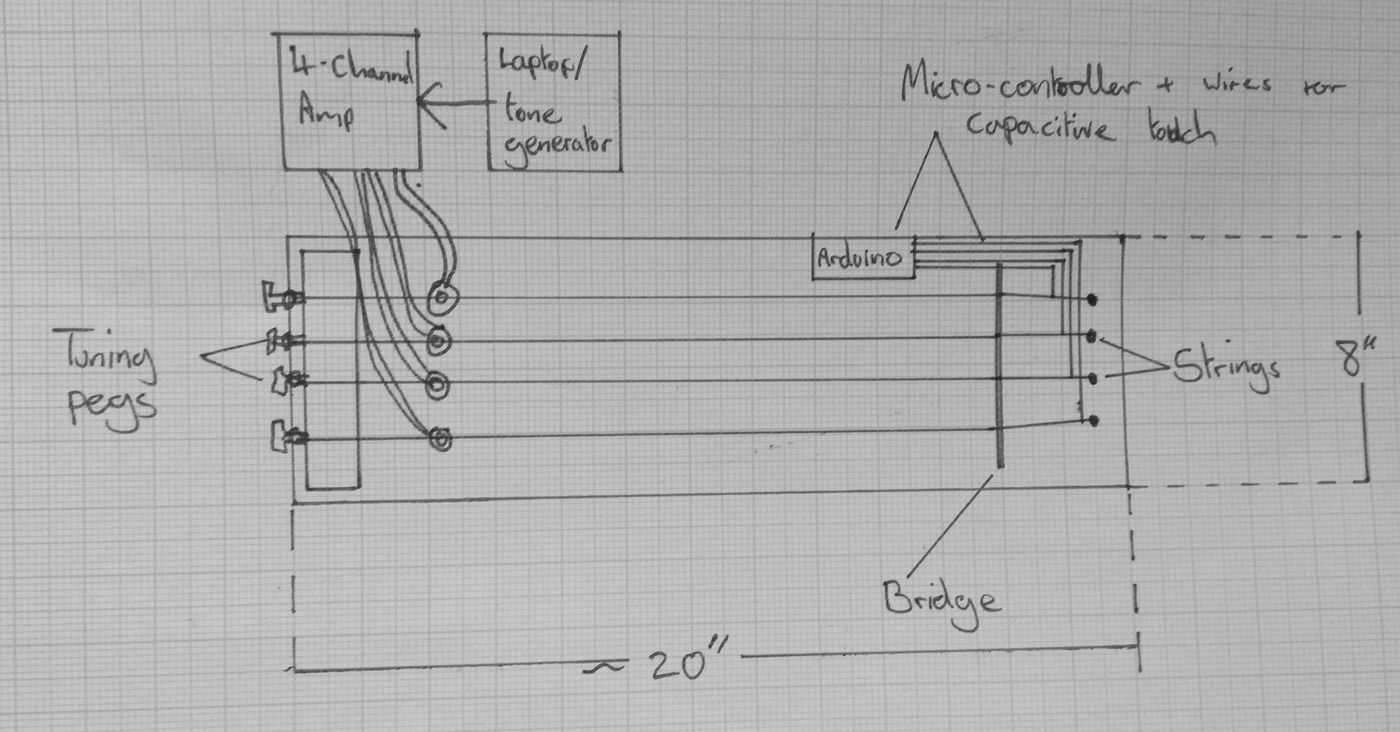
I tried to keep the design as simple as possible – a 20” by 8” board for the base, and two small bits of wood, one for the bridge, one for the tuning pins.
Instrument:
Plywood for main body and 2 bridges
Tuning pegs
Strings – (any ferrous metal string should work – further experimentation needed to see which is most suitable)
Electronics:
Magnets – according to the specifications in Andrew Mcpherson’s paper, these should work well
Four channel power amplifier
Pots, microcontroller, jumper wires, resistors etc for capacitive touch
To become more familiar with the physics at play, I set about making an electromagnet and testing it on a small lap harp of mine. I followed these, instructions to make it. After this, I connected both ends of the magnet wire to an amplifier and played through a sine wave at the frequency of the string. To my surprise it worked quite well, although the amplifier I was using wasn’t so powerful (10W), so realised I would need a more powerful amp for the final design. I also tested out different waveforms to play through the magnet to see if there was a change in volume or timbre, but they were not so noticeable. Playing the different harmonics of the fundamental also excited the string in to vibration, which is definitely something I would like to exploit in my final design.
For my project, I would like to create an electro-acoustic string instrument, exploring the timbral possibilities which arise from actuating the strings via electromagnets, as detailed in Andrew McPherson’s paper regarding the creation of the Magnetic Resonator Piano. The instrument would be a small zither-like instrument with around 4 strings and as many electro-magnets. The electromagnets would be connected to speaker terminals of a power amplifier, which would send an audio signal through the magnets which corresponds to the fundamental of the string. I’m also interested in incorporating capacitive touch to trigger which string sounds, i.e. when the performer gently touches a string before the bridge, it begins to vibrate.